Energy
Capital programmes run for years and every plan change needs a record. You keep the approved baseline, the budget version and the decision in one place.
See the energy sector
Altus focuses on portfolio management inside Microsoft 365. FlexiProject delivers the same scope as a standalone system — project charter, products, approval paths and budget versions. Choose between one ecosystem and full independence.
Trusted by


| Try for free | Altus | |
|---|---|---|
| Gantt chart and Kanban board | ||
| Baseline and variance against the plan | ||
| Risk register | ||
| Project budget with costs and revenue | ||
| Project products with acceptance criteria linked to tasks | ||
| Project portfolios | ||
| Project scoring with your own criteria and weights | ||
| Portfolio simulation | ||
| Strategic goals with KPIs linked to projects | ||
| Resource workload | ||
| Time tracking | ||
| Jira integration | ||
| Works without Power Apps and Power BI licences | ||
| On-premises edition | ||
| Configuration without an implementation consultant | ||
| Test account set up on your own, without a form | ||
| Unlimited free users | ||
| Interface in 28 languages |
Altus works where the whole organisation already runs on Microsoft 365. FlexiProject adds the same practice without those licences: charter, budget, products and risks. Book a demo.

Five modules that cover decisions about the plan, not only its status. Each one works at project and portfolio level.
The charter holds goals, scope and success measures, and pulls data from the schedule, budget and risks. You pick the template per project type.

Multi-stage and parallel approval paths cover the charter, the plan and the budget. Each decision keeps the person, the date and the comment.

Every product has an owner, a deadline and acceptance criteria. Tasks that deliver it are linked, so scope and schedule stay together.

Reviews run on a fixed cycle per portfolio, with reminders and a company report format. Decisions and comments go to the archive.

One template carries the schedule, budget, risks and products at once. A finished project becomes a template in a single click.
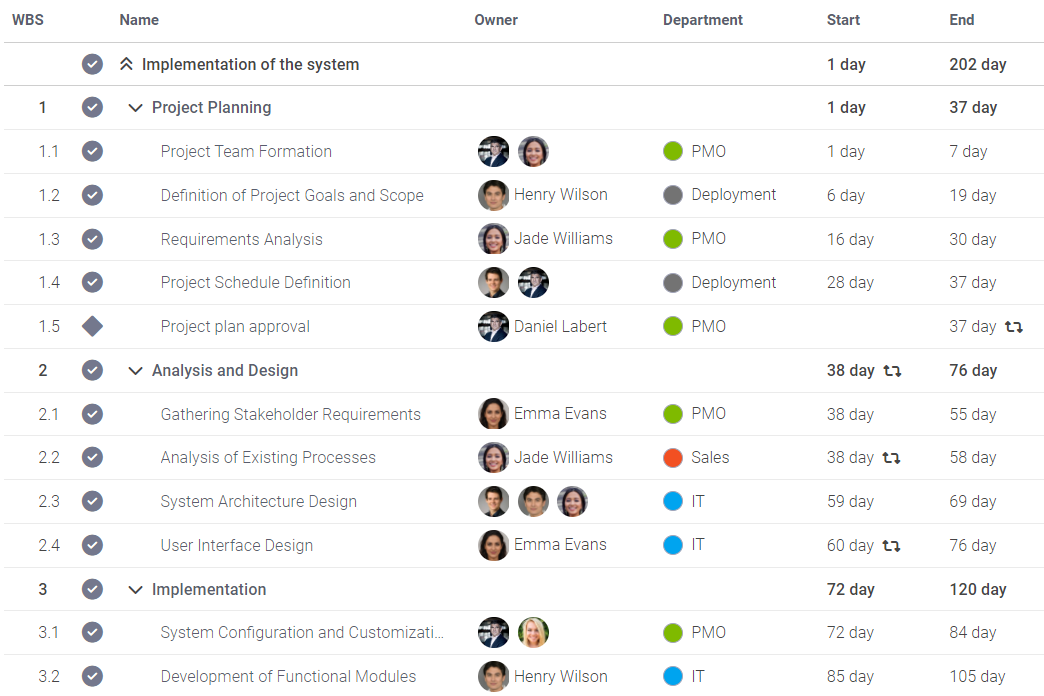
The budget holds costs and revenue, spend to date and the forecast to completion. Every change goes through an approval path. The previous version stays available for comparison.

A change to the plan starts with a request and a justification. After approval the new baseline replaces the old one. Every approved version stays for comparison.

Capital programmes run for years and every plan change needs a record. You keep the approved baseline, the budget version and the decision in one place.
See the energy sectorPublic projects are settled against documents, not dashboards. The charter, the approval path and the review archive answer an audit without extra work.
See local government
Research projects run for years and are settled against grant documents. Every product, cost and decision keeps its own record.
See R&D organisations
Manufacturing, engineering, finance and construction work to the same rules. Pick the industry closest to yours.
All industries
Every comparison follows the same table, so you can read two systems side by side.
Altus runs projects and portfolios inside Microsoft 365, in your own tenant. FlexiProject works as a standalone system and needs no Power Apps or Power BI licence. If the organisation does not stand entirely on Microsoft 365, that single condition decides. See what FlexiProject offers in one place.
Yes. Altus consolidates schedules from Microsoft Project, Planner and Jira. FlexiProject also connects to Jira, so a development team keeps its own tool while the PMO works in one place. See the Jira integration.
Altus uses the Power Platform interface, familiar to Microsoft 365 administrators. FlexiProject has its own interface and you configure it without a consultant. The answer depends on who maintains the system after go-live. Start with workspaces.
Yes. Altus offers a Timeline view, a Board view, task dependencies and baselines with variance. The schedule can also stay in Microsoft Project, Planner or Jira and sync into Altus. In FlexiProject one Gantt chart covers the whole project, in the browser.
In FlexiProject a change starts with a request and a justification and ends with an approval. The earlier versions stay for comparison, so you can show what moved and why. See the project plan.
FlexiProject imports and exports .mpp files. Altus links to an .mpp file through an add-in installed on the user’s computer. Its documentation notes that baselines from that file are not published into Altus. See how the project schedule works in FlexiProject.
Yes. Altus tracks the budget, the forecast and actual cost, with rates and cost taken from approved timesheets. In FlexiProject the project budget adds versions and approval of every change.
Both systems keep a risk register at project and portfolio level. FlexiProject lets you set your own risk matrix and tie a risk to a specific task in the schedule. See project risks.
In FlexiProject a product has an owner, a deadline and acceptance criteria, and it points to the tasks that deliver it. The Altus help centre states that key dates and deliverables are not linked to schedule tasks by default. See project products.
Yes. Altus has portfolios, programs, weighted evaluation criteria and a prioritisation exercise. The portfolio layer starts in the Portfolio plan and strategic goals in the Strategy plan. In FlexiProject project portfolios come with every licence.
Altus insights are delivered in Power BI, and its documentation lists Power BI Pro or Premium capacity per user. FlexiProject builds reports and dashboards inside the application, with no separate licence.
In FlexiProject reviews follow a fixed cycle per portfolio, with reminders and an archive of decisions. Data comes from the project modules, so nobody rewrites it into slides. See project reviews.
Altus technical documentation lists a Power Apps licence for every user. It also lists Power BI Pro or Premium capacity and a licence that grants Microsoft Teams. FlexiProject needs none of them and runs in the browser. See project management in FlexiProject.
FlexiProject has a server edition with no functional limits. Altus runs only on the Power Platform, and its documentation marks disconnected Microsoft 365 Local as unsupported. The same modules and the same project templates work in both variants.
FlexiProject runs in 28 languages. Altus documentation states that English is currently the only active language in its own components and that error messages appear in English. The in-app knowledge base follows the interface language.
Schedules move as .mpp files or an Excel import, the rest through CSV and the API. Charters, templates and approval paths you set up yourself during the trial. Start with the integrations.
The Altus price list of September 2026 starts at 1,440 USD per month billed annually, with ten Manager licences included. Each additional user costs 5 or 10 USD. FlexiProject publishes its pricing and puts no limit on free users.
You set up the account yourself, with no form and no call, and you get full access for 30 days. The Altus trial also lasts 30 days, but it starts with a form and a conversation with their team. See project scoring during the test.
Tell us how your projects are run today and which decisions need a record. We will show the same case in FlexiProject.