Project deliverables vs product deliverables: differences
Every project produces two kinds of results: the outputs it was commissioned to build and the outputs it needs to manage itself. The first are product deliverables, the second are project deliverables, and both are deliverables in the full sense: verifiable, owned, and handed over for acceptance. The difference lies in their function and their audience, and confusing the two leads to real problems: clients asked to approve internal paperwork, or products accepted by people who will never use them. This article defines both types, compares them side by side, shows where the distinction matters in practice, and explains how to track both in one system.

Key takeaways:
- Definitions — project deliverables are outputs created to plan, steer, and document the project itself; product deliverables are the outputs the project was commissioned to produce.
- Examples — project deliverables include the project plan, schedule baseline, status reports, and risk register; product deliverables include the system, the building, the campaign, or the acceptance test results.
- Key differences — project deliverables serve internal recipients such as the sponsor and the PMO; product deliverables go to the client or end users and are accepted against agreed criteria.
- Common mistakes — tracking only product deliverables leaves the project without a decision trail; overproducing project deliverables turns management into reporting for its own sake.
- Managing both types — product deliverables need owners, acceptance criteria, and status visible next to the schedule; project deliverables need approval workflows and reports generated from live data.
What are project deliverables?
Project deliverables are the outputs created to plan, steer, and document the project itself: the project plan, the schedule baseline, status reports, the risk register, meeting minutes, budget documentation. They are sometimes called process deliverables, because they are produced by the management process rather than by the production work, or internal deliverables, because their recipients sit inside the organization. One terminology note is needed here: in everyday usage, project deliverables also serves as the umbrella term for all project outputs of any kind, and that broader sense is covered in our guide to project deliverables. In the comparison discussed in this article, the term refers specifically to the management side.
What makes these outputs full deliverables rather than paperwork is that they meet the same test as anything else the project hands over: each is verifiable, has an owner, and has a recipient who accepts it. A schedule baseline is approved by the sponsor; a status report is received by the steering committee. These outputs exist so that decisions can be made on facts, and a project that produces none of them can still build a product, but nobody will be able to say on what basis it was steered.

What are product deliverables?
Product deliverables are the outputs the project was commissioned to produce: the software system, the new feature, the building, the marketing campaign, the training program, the acceptance test results that confirm the product works. They are sometimes called final deliverables, because they represent the end results of the work, or external deliverables, because they leave the project and go to the client or end users.
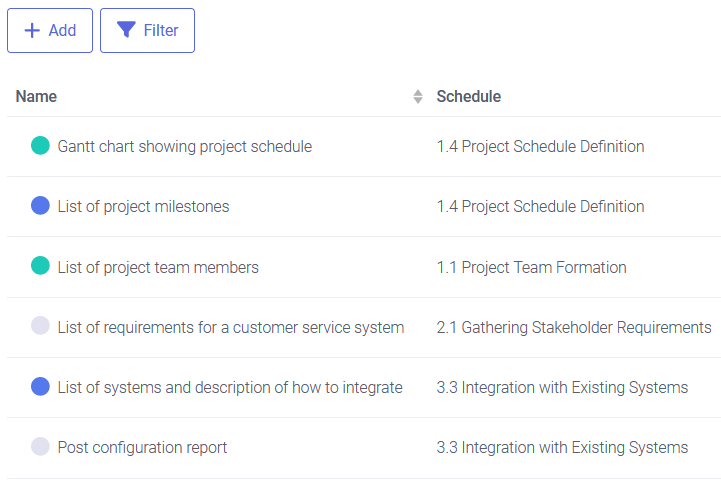
Product deliverables are the reason the budget exists. They are accepted against acceptance criteria agreed before the work started, usually by the client, the product owner, or the end users, and their handover is what closes the project’s core promise. A project can be exemplary in its plans and reports, but if the product deliverables fail acceptance, none of the management discipline redeems it. That is why acceptance status deserves its own tracking: in FlexiProject, the task on the schedule carries an icon with the status of the related product, so the difference between a completed task and an accepted deliverable is visible at a glance.
Project deliverables vs product deliverables: comparison
| Project deliverables | Product deliverables | |
| Purpose | Plan, steer, and document the project | Deliver the results the project was commissioned for |
| Typical recipients | Sponsor, steering committee, PMO | Client, product owner, end users |
| Examples | Project plan, schedule baseline, status reports, risk register | System, feature, building, campaign, acceptance test results |
| Acceptance | Internal approval, often through a formal workflow | Acceptance against criteria agreed with the client |
| When produced | Throughout the project, from initiation to closure | Mostly in execution, handed over at stage ends and closure |
Two things follow from the table. First, both types pass the same deliverable test: verifiable, owned, accepted. The difference is function and audience, not rank, and treating project deliverables as second-class paperwork is how organizations lose their decision trail. Second, the healthy proportion between the two types is not fixed. A regulated pharma project legitimately produces more management outputs than a two-person marketing project, and the proportion should follow the project’s risk profile rather than a universal template.
Why the distinction matters
Different recipients and acceptance paths
Each type travels a different route to acceptance. Project deliverables are approved internally: the sponsor signs off the baseline, the steering committee receives reports, the PMO checks compliance with standards. This internal route can be formal: in FlexiProject, the baseline and key documents are approved through an acceptance path, so the sponsor’s sign-off is an event recorded in the system rather than a hallway agreement. Product deliverables are accepted by the client or users, against criteria written down before the work began. Problems start when the routes get mixed: a client asked to approve an internal risk register wastes everyone’s time, and a product declared accepted by the team that built it, without the client’s sign-off, is a dispute waiting for the invoice.

Common mistakes in tracking both types
The first mistake is tracking only product deliverables. The product gets built, but there is no approved plan, no baseline, no record of decisions, so when an audit, a handover, or a dispute arrives, the project has nothing to show for how it was run. The second mistake is the opposite: overproducing project deliverables until management becomes reporting for its own sake, and the team spends more time documenting work than doing it. Both mistakes have the same root, which is copying the deliverable list from a template instead of deriving it from the project’s actual risk and stakeholder needs.
What PRINCE2 calls these two types
The distinction described in this article has formal names in PRINCE2: management products for the project side and specialist products for the product side, each defined with its own description and quality criteria. If your organization works with PRINCE2 or you want the framework perspective on the same split, see our comparison of project deliverables (PMBOK) and project products (PRINCE2).
Unlock all features and boost your projects, enjoy 30 days of FlexiProject free!
How to manage both types in one system
The two types need different mechanics, but they should live in one place. In FlexiProject, product deliverables are defined in the Products module: each with its description, acceptance criteria, deadline, and owner, linked to the tasks and milestones that produce it. Project deliverables gain from another direction. Recurring status reports are generated from live project data, which removes the most time-consuming management output from the manual to-do list, and a risk register kept in the system instead of a spreadsheet is always current for the review, with no inputs collected by email. The result is that both types have named owners and a visible status, without a parallel spreadsheet for either.

Project deliverables vs product deliverables: FAQ
Is a status report a project deliverable or a product deliverable?
A project deliverable. It documents the state of the work for internal recipients and supports steering decisions. It would become part of a product deliverable only in the rare case where reporting itself is the commissioned service.
Are project deliverables the same as process deliverables?
In practice the terms overlap almost completely. Strictly speaking, process deliverables are named for when they are produced, by the management process, and internal deliverables for who receives them. Most outputs qualify under both names, which is why the labels are used interchangeably.
Who accepts each type of deliverable?
Project deliverables are accepted internally, by the sponsor, steering committee, or PMO. Product deliverables are accepted by the client, product owner, or end users, against criteria agreed in advance. Keeping the two acceptance paths separate prevents most handover disputes.
Can one item be both a project and a product deliverable?
Yes. User documentation is the classic case: it is produced during the project like any management output, but it ships with the product and serves end users. The deciding factor is the final recipient. If the client or users receive it, treat it as a product deliverable with acceptance criteria.
Project deliverables and product deliverables split the outputs of a project by function and audience: one set exists to run the project, the other is what the project was commissioned to produce. Both deserve the full deliverable treatment, with owners, verifiability, and a defined acceptance path, because a project that neglects either side pays for it: without project deliverables there is no decision trail, and without accepted product deliverables there is no result.
The distinction is also practical rather than academic, since each type travels a different route to acceptance and serves different recipients. A PPM system that handles both mechanics in one place, the way FlexiProject does with the Products module for product deliverables and approval workflows with automated status reports for project deliverables, keeps the two sides visible without doubling the administrative work.